Dwarf planet · Kuiper Belt

Pluto

A distant dwarf planet with icy mountains, flowing glaciers and a thin, layered atmosphere.

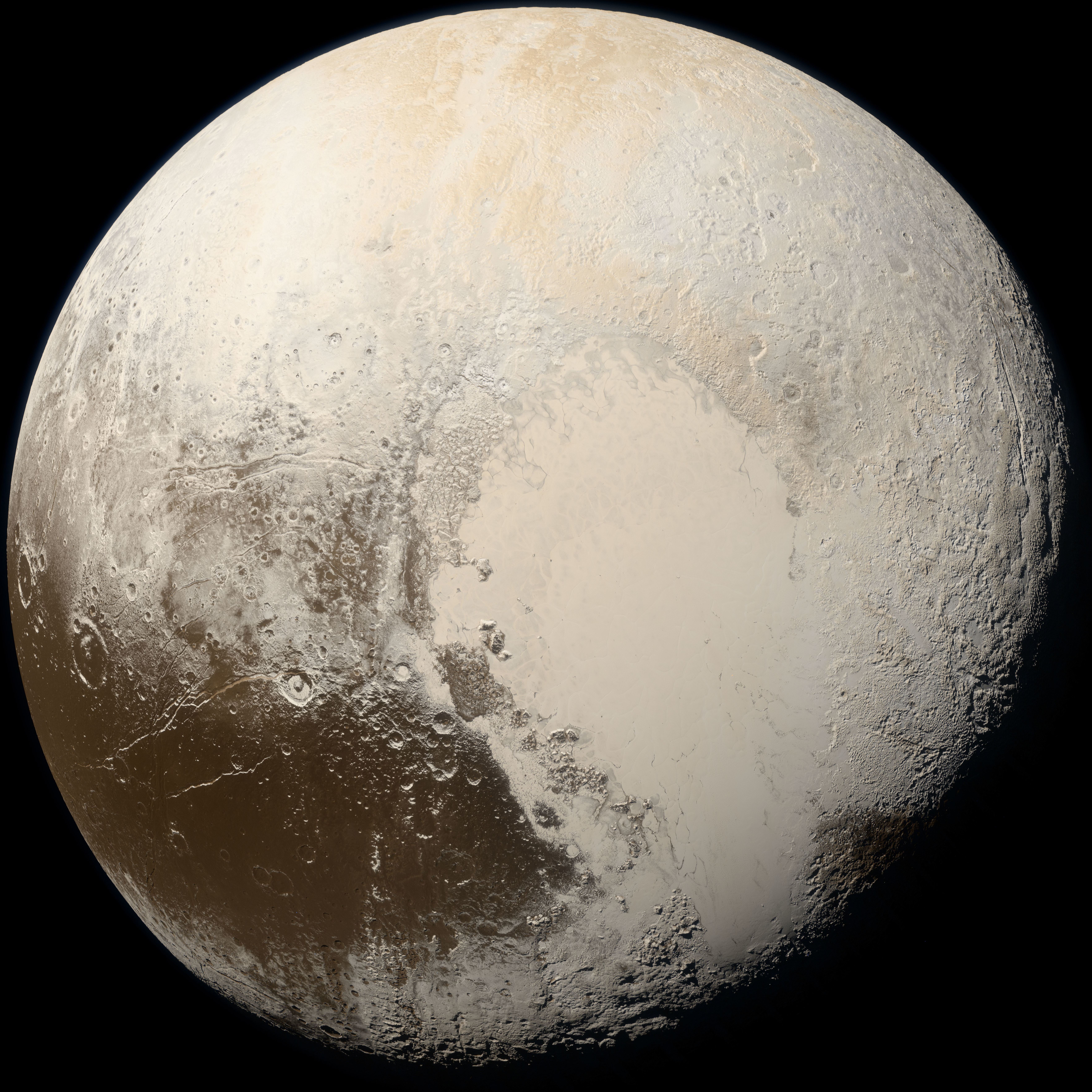
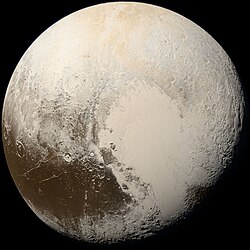
New Horizons enhanced-color view of Pluto
NASA / Johns Hopkins APL / Southwest Research Institute — New Horizons.
Discovered1930
Diameter≈ 2,377 km
Day6.39 Earth days
Known moons5

Pluto in the Kuiper Belt

Pluto is a dwarf planet in the Kuiper Belt, a vast region of icy bodies beyond Neptune. Its eccentric, inclined orbit carries it around the Sun once every 248 Earth years.

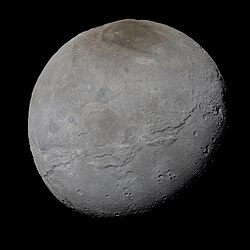
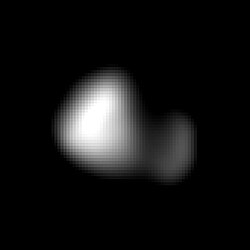
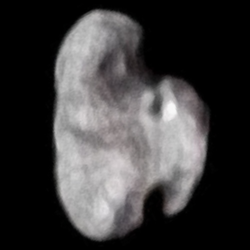
Five known moons belong to the Pluto system: Charon, Styx, Nix, Kerberos and Hydra. Charon is so large relative to Pluto that the pair orbit a common center of mass located outside Pluto.

What New Horizons revealed

NASA’s New Horizons spacecraft flew through the Pluto system on July 14, 2015, providing the first close-up observations of Pluto and its moons. The mission revealed water-ice mountains, nitrogen-ice plains and glaciers, impact craters, and layered atmospheric haze—transforming scientists’ understanding of Pluto as a geologically diverse and dynamic world.

NASA’s New Horizons mission made the first close reconnaissance of the Pluto system in July 2015.
Interactive visualization

Explore the Pluto system in 3D

NASA’s Eyes on the Solar System places Pluto in its wider solar system setting and lets you examine the Pluto–Charon system in three dimensions. Rotate the view, zoom in or out, and use the time controls to follow the modeled motion of the system.

NASA Eyes on the Solar SystemPluto system
Current time: Open full screen ↗
Mouse / touch orbit and inspect Scroll / pinch zoom Time controls rewind or fast-forward Full screen best on tablets and phones

NASA Eyes is an interactive visualization provided by NASA/JPL and loads from eyes.nasa.gov. If the embedded view is unavailable, use the full-screen link above.

The Pluto system

Pluto and its five moons

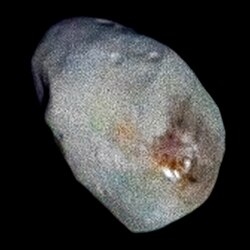
Pluto has five known moons. Charon is by far the largest and forms a closely coupled pair with Pluto. Farther out, the four much smaller moons—Styx, Nix, Kerberos and Hydra—follow nearly circular orbits around the Pluto–Charon system.

Keep exploring

Continue exploring

NASA Science provides mission background, observations and image collections; Wikipedia offers a broader reference overview with citations.